Leading the Clean Energy Transition
Our maritime services are essential for the construction and ongoing operations and maintenance of offshore infrastructure projects that produce cleaner energy with lower emissions, and for the storage and transportation of low-carbon gases including LNG and ammonia - a carrier of hydrogen.
In a future where green hydrogen and its derivatives such as green ammonia are produced using renewable electricity from offshore wind, and as blue hydrogen and its derivatives such as blue ammonia, are produced using carbon capture, our services will be used by our global energy customers across the renewable energy value chain.
We also transport ethane, a low-carbon gas offering a cleaner and more resource-efficient feedstock for industrial applications and ethylene production. Our dual-fuel VLEC fleet further strengthens this value chain by using ethane boil-off gas for propulsion, minimising cargo loss and improving tank pressure management to deliver meaningful cost savings and emissions reduction.
What's new in sustainability: Highlights from our 2024 report
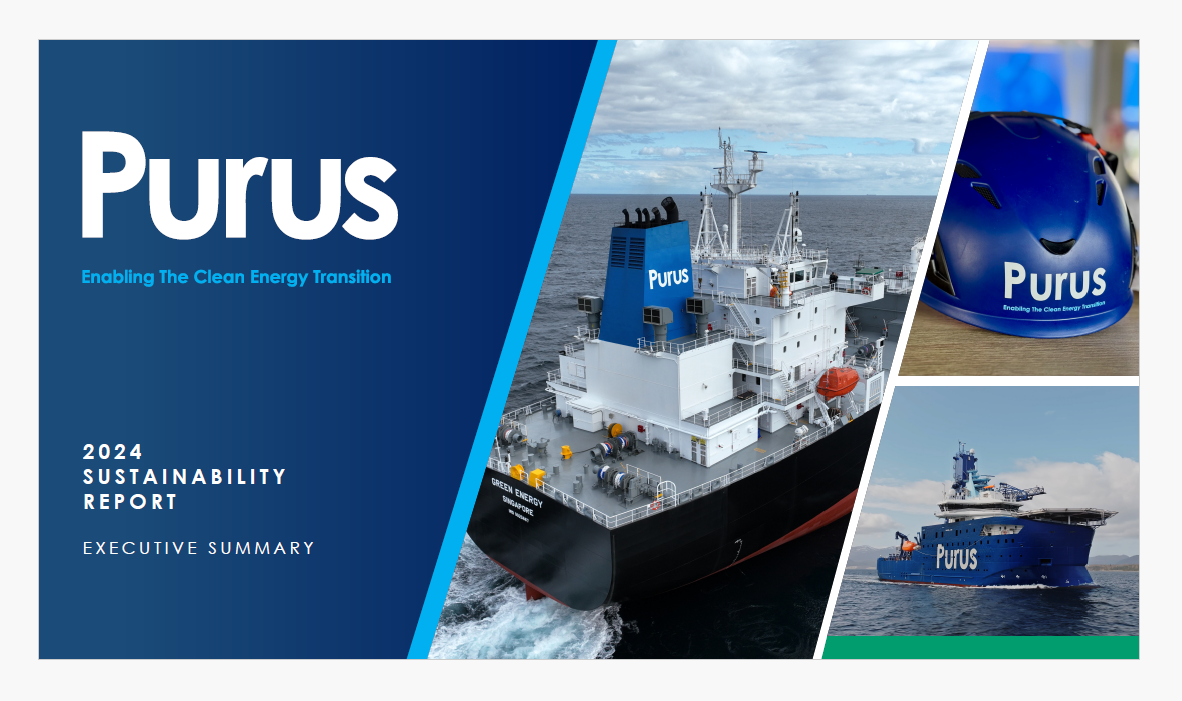
Read more to find out how Purus is Enabling The Clean Energy Transition
Purus is proud to present an executive summary of our 2024 Sustainability Report, which underscores our continued commitment to environmental stewardship, social responsibility, and ethical governance.
This document provides an overview of key material environmental, social, and governance (ESG) performance metrics for 2024.
To view the full report, which includes how Purus identifies and mitigates ESG risks while capitalising on related opportunities, please email
ESG@purus.com.
Low-carbon vessels and an ambition for part of our fleet to be capable of net zero carbon operations from 2030
Our Decarbonisation Strategy:
- Focus on low-carbon newbuild assets incorporating the latest commercially viable technologies, to reduce carbon emissions upon delivery compared to conventional peer vessels
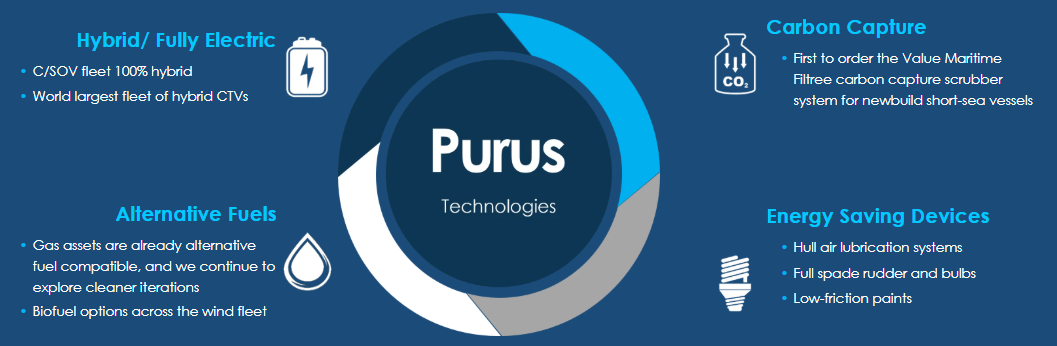
- Net zero carbon operational capability targeted across parts of our gas and offshore infrastructure fleet from 2030 in terms of fuel source emissions, through a tailored mix of energy-saving devices, voyage optimisation tools, enhanced operational efficiency measures, alternative fuels, and integration of hybrid propulsion systems
- Phased approach due to evolving landscape of technology commercialisation
We recognise that the decarbonisation journey faces external constraints such as the availability of low-carbon fuels, technology and commercial dependencies, that could impact the timing of achieving our ambition.
Decarbonisation technologies towards net zero
As part of our broader sustainability framework, Purus is commited to building exploratory expertise in emergent decarbonisation technologies, allowing us to apply the knowledge and insights across our core gas and offshore infrastructure fleet over time. In doing so, Purus provides a fleet of environmentally-advanced low-carbon vessels to the market, facilitating the supporting infrastructure and operational capacity essential for enabling the maritime energy transition.
We have leveraged our CTV and C/SOV hybrid battery expertise to enhance the performance of our upcoming offshore infrastructure vessel types, and our biofuel handling capabilities to provide drop-in fuel options for offshore infrastructure customers. The carbon capture experience from our short-sea technology system will deliver strategic competitive advantage in deployment to deep-sea systems, when they become available.



Technology: Carbon Capture
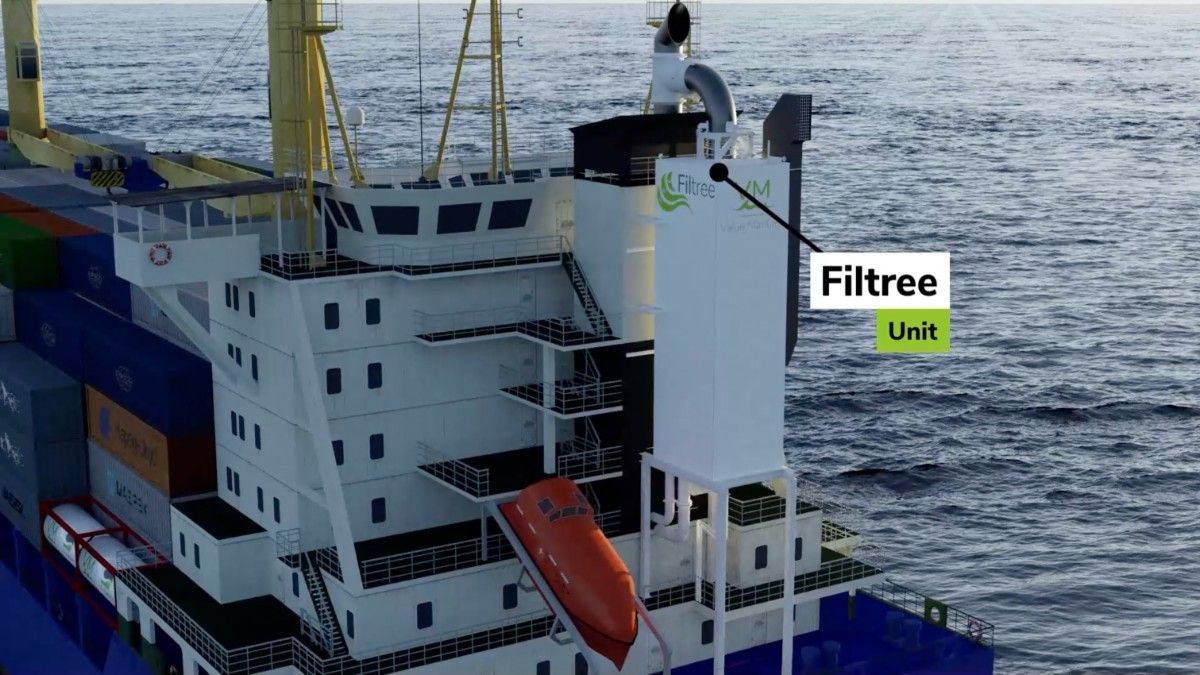
Value Maritime’s Filtree system
Purus has placed an order with Value Maritime for four emissions-reducing Filtree Systems, including Clean Loop System and 30% carbon capture, installed on our newbuild 1,400 TEU feeder container vessels operated by BG Freight Line, part of Peel Ports Group. Purus is the first company to install such technology on a newbuild container vessel. The 12.5 MW systems were installed following yard delivery during H1 2024.
Carbon circle
The Filtree Systems feature a modular CO 2 capture and storage system. This innovative technology captures CO 2 from exhaust emissions and uses it to charge a “CO 2 battery”, where it is stored and transported to shore. On shore, the CO 2 is discharged for use, for example, in the agricultural industry, after which the battery is returned to the vessel to be recharged, thus representing a 100% circular solution.
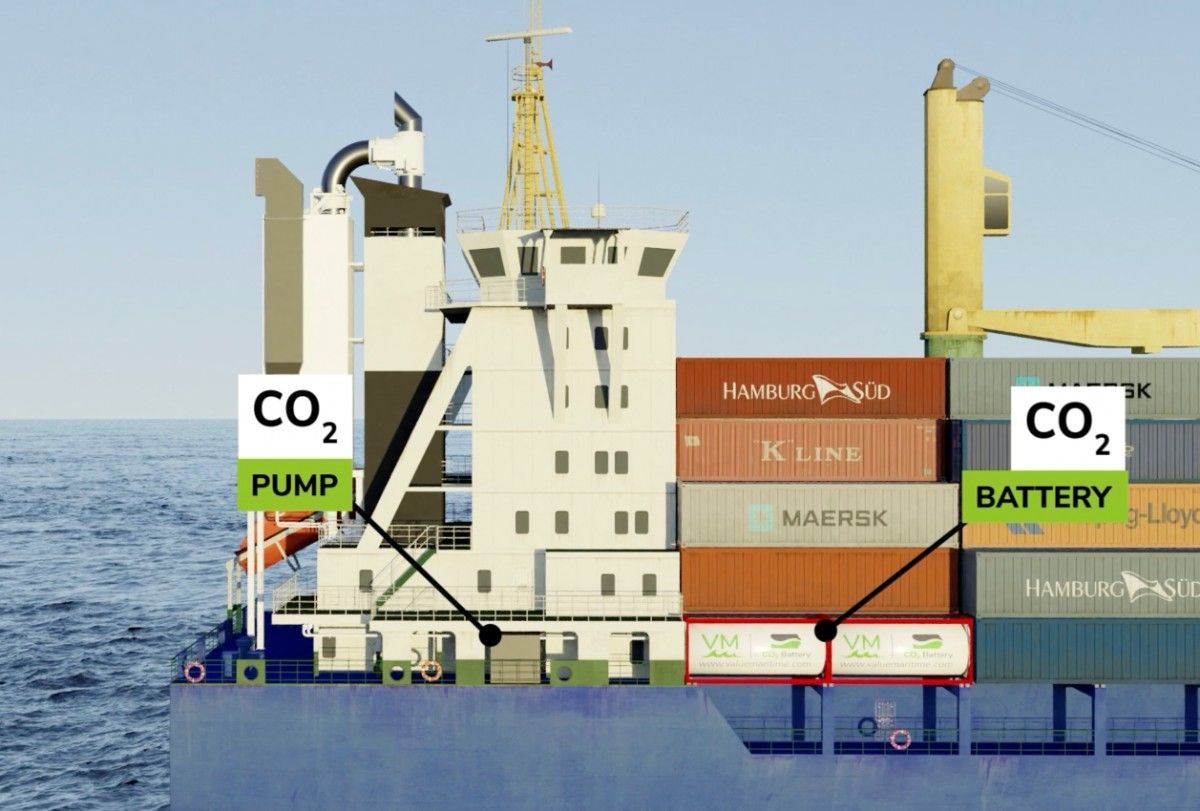
Explore how the carbon capture system works
Alignment with UN Sustainable Development Goals (SDGs)
Our vessels implement the latest in carbon reduction technologies, including battery hybrid propulsion, carbon capture systems, low-carbon fuels and high-impact energy saving devices that reduce carbon emissions immediately, with strategies to further reduce carbon in the future.
Our people who operate our vessels are highly skilled, bringing industry best practices and safe, cost-effective and low-carbon transport solutions. We seek a diverse work environment that fosters equity and inclusion to support a sustainable business.
Our know-how brings together knowledge from multiple sectors to integrate decarbonisation technologies across our business.





Our Memberships & Commitments
Collaboration is at our core.
Beyond working with our customers and suppliers, we work with industry groups across the maritime and energy value chain to develop ideas and foster innovation towards a low-carbon future for all.